How many restrooms does a county fair need?
Start with attendance, not guessing. OSHA 1926.51(c) sets construction-site ratios at one toilet for 20 workers or fewer, which fairs use as a rough baseline before scaling up for public crowds who cluster around food and stages rather than spreading evenly like a job site. A fair drawing a few thousand people across a weekend typically needs standard units placed in banks near entrances, the midway and grandstand seating, not just one central bathroom trailer. Our how many porta potties do I need guide walks through the math by expected headcount and event hours.
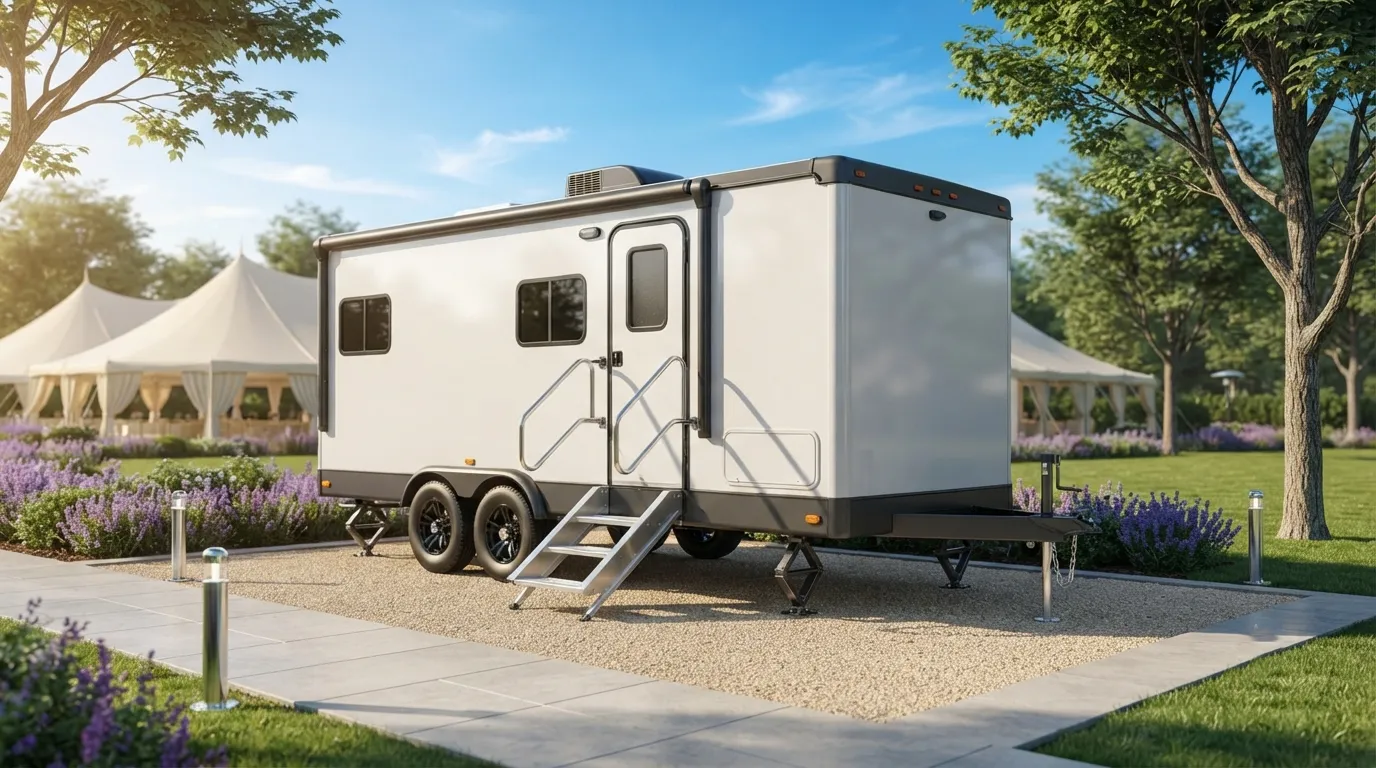
Every fair layout in Arlington Heights should include at least one accessible unit under ADA Standards section 213.2, which requires 5 percent of clustered single-user units to be accessible, with a minimum of one no matter how small the cluster. That unit needs a 60 inch turning circle per ADA 304.3.1 and a clear route at least 36 inches wide per ADA 403.5.1, so we walk the fairground with organizers before drop-off to confirm gravel paths and grass lots can carry that width. Standard units run about 44 by 48 inches on the ground and stand roughly 92 inches tall, which matters when placing them under tents or near overhead wiring. For fairs wanting something nicer near VIP seating or a beer garden, a restroom trailer rental with flush fixtures and running water often works better than a bank of standard units.
What does county fair restroom rental cost?
Pricing depends on unit count, rental length and whether you want standard units, ADA units or a full trailer. Multi-day fairs usually book by the week rather than the day, and delivery adds a flat fee on top of unit cost.
| Unit | Day | Week | Notes |
|---|---|---|---|
| Standard | $100-$350 | $130-$500 | good for general crowd coverage |
| ADA accessible | $200-$400 | $240 and up | required in every cluster |
| Deluxe flushable | $85-$1,200 | $150-$290 | better for VIP or sponsor areas |
| Delivery fee | $100-$500 | $150 and up | flat, charged once per trip |
See our porta potty rental cost page for a broader breakdown, or check monthly porta potty rental pricing if your fair runs an extended season. A weekend-only fair often does better on our weekend rate than a full week booking, since weekend pricing on standard units runs a set band separate from daily or weekly rates. For fairs adding a wash station near food vendors, a handwashing station rental satisfies 29 CFR 1910.141(d)(2), which requires soap and towels or a hand-drying device at wash stations, since hand sanitizer alone does not meet that standard.
Where do restrooms get placed on a fairground?
Placement follows foot traffic, not the middle of an open field. Fairgrounds in Arlington Heights vary in surface, and gravel lots, mowed grass and paved lots each affect how close a delivery truck can get. Our crews need about 60 feet of straight clearance behind the truck to unload safely, so we scout access points along fences and gates before the fair opens. Units go near the midway entrance, food vendor rows, the grandstand and any beer or wine garden, with an ADA unit in each cluster rather than one accessible unit for the whole grounds.
If the fair includes livestock barns or 4-H exhibits, we treat those areas like farm and agricultural restrooms zones and add units near the barns separately from the midway cluster. Food vendors applying sauces, marinades or using degreasers may trigger OSHA 1926.51(f)(1) washing facility requirements, which cover paints, coatings, herbicides, insecticides and similar contaminants, so we ask vendors what they are working with before finalizing wash station count. For fairs running past dusk, pair restroom placement with a light tower rental near the units so lines stay visible after the sun goes down. Fairs near Mount Prospect, 3.7 miles southeast, or Palatine, 4.6 miles west, follow the same placement logic since fairground layouts across the area share similar space constraints.
How far in advance should we book fair restrooms?
Book as soon as your date and headcount estimate are set, ideally 60 to 90 days out for multi-day fairs. Popular fair weekends fill delivery slots fast. A request a quote submitted early locks in unit count before other events on the same weekend compete for trucks.
Can we mix standard units with a restroom trailer?
Yes, and many fairs do. Standard units handle general midway traffic while a restroom trailer rental covers VIP seating or a beer garden with flush fixtures. Mixing unit types by zone often costs less than upgrading every unit to trailer-grade.
Do fairs need a separate wash station for food vendors?
Often yes, especially if vendors handle raw ingredients or use cleaning chemicals. A portable sink rental near the vendor row keeps hands clean without pulling staff away from their booth. Check with vendors on what they are using before the fair opens.
What happens if a unit runs low mid-fair?
Call us and we will route a service truck same day when possible. Multi-day fairs often schedule a mid-event service pass automatically, following the weekly service interval baseline from ANSI/PSAI Z4.3 for high-use events.
Is a permit needed for restroom placement on fairgrounds?
That depends on the property and whether units sit in a public right of way, so this needs confirming with the City of Arlington Heights before delivery. Our porta potty permit requirements page explains what to check before booking.
Next step
Get a delivery date
Tell us the address, the dates and the headcount. We size the order and confirm the route.